Last updated: November 12, 2026
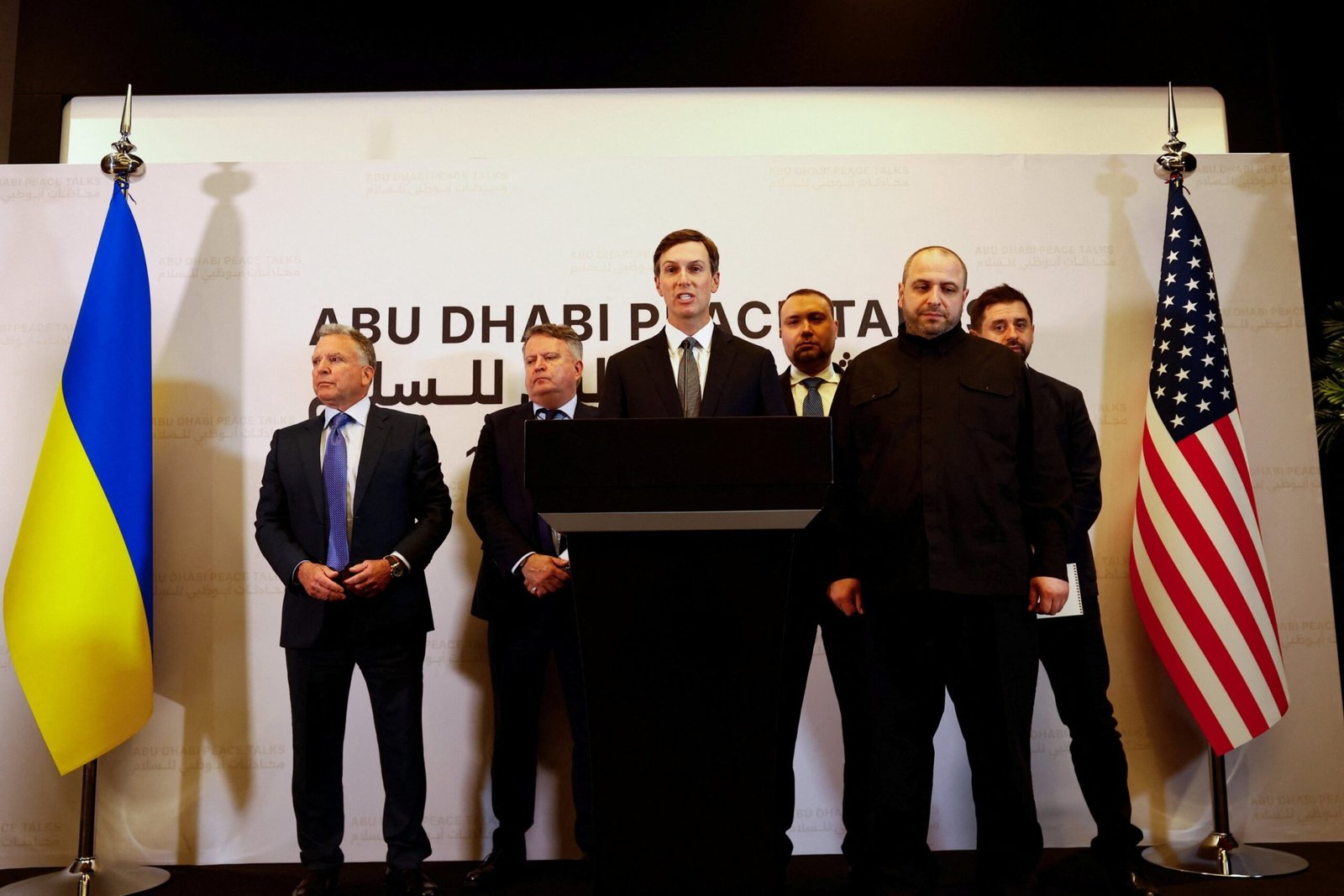
Two days of closed-door diplomacy in the United Arab Emirates ended without a ceasefire, yet they produced the clearest diplomatic movement in months. As the Abu Dhabi Ukraine peace talks concluded, U.S. envoys Jared Kushner and Steve Witkoff announced a major humanitarian breakthrough alongside a high-stakes shuttle schedule taking them directly to Moscow today, November 12, before flying to Dublin for consultations with Ukrainian President Volodymyr Zelenskyy.
For global markets, energy traders, and citizens watching the conflict enter another winter, separating diplomatic optimism from hard territorial realities is critical. Below is an objective breakdown of what negotiators actually agreed to in Abu Dhabi, where the talks remain deadlocked, and what happens next over the next 48 hours.
Quick Answer: Where the Abu Dhabi Peace Talks Stand
- Major Breakthrough: Negotiators aligned on a planned prisoner exchange involving more than 1,000 prisoners from each side.
- Main Sticking Point: Territorial control—specifically Moscow’s demand for the entire Donbas region and parts of southern Ukraine that Kyiv still holds.
- Next Steps (Nov 12): U.S. envoys Kushner and Witkoff meet Russian President Vladimir Putin in Moscow today, followed by talks with President Zelenskyy and European partners in Dublin.
Table of Contents
- 3 Key Outcomes From the Abu Dhabi Ukraine Peace Talks
- Where Moscow, Kyiv, and Washington Stand
- Why the Territorial Dispute Remains Unresolved
- What This Means for Global Markets and Energy
- Frequently Asked Questions
3 Key Outcomes From the Abu Dhabi Ukraine Peace Talks
1. A 1,000-for-1,000 Prisoner Exchange Framework
While a comprehensive truce proved out of reach in the UAE, negotiators finalized plans for one of the largest prisoner exchanges of the war, expected to return more than 1,000 captives to each country. U.S. envoy Jared Kushner described the swap as a confidence-building measure designed to reunite families and establish working trust before tackling harder political terms.
2. Direct Shuttle Diplomacy to Moscow and Dublin
Rather than letting momentum stall after the UAE sessions, Washington immediately escalated the talks to the leadership level. Kushner and Witkoff are scheduled to meet President Vladimir Putin in Moscow on Thursday, November 12, to present proposals coordinated with Kyiv and European allies, before traveling to Dublin to brief President Zelenskyy.
3. Year-End Deadline Pressure
Ukrainian negotiator David Arakhamia noted after the sessions that negotiators see momentum to pursue a broader framework before the end of 2026. However, officials across all three delegations cautioned that complex structural details remain unfinished.
Editorial Insight: Large prisoner exchanges have historically served as the litmus test for whether warring parties can verify and honor mutual commitments. If the 1,000-person swap executes smoothly over the coming weeks, it creates a functioning verification channel that could later monitor a localized ceasefire.
Where Moscow, Kyiv, and Washington Stand
Each party enters today’s follow-up meetings with sharply defined red lines:
| Delegation | Core Priority | Non-Negotiable Red Line |
| Ukraine (Kyiv) | Sovereign borders, durable Western security guarantees, POW returns | Refuses to cede territory currently defended by Ukrainian forces |
| Russia (Moscow) | Full control of Donbas and southern annexed regions, sanctions relief | Demands territorial concessions before halting military pressure |
| United States (Washington) | Rapid diplomatic settlement, structured negotiation pathway | Balancing Kyiv and European alignment with Moscow’s demands |
| European Union | Continental security architecture, unified sanctions policy | Insists Washington cannot unilaterally lift EU sanctions on Moscow |
Why the Territorial Dispute Remains Unresolved
Despite upbeat public remarks regarding logistics and humanitarian progress, Kushner openly acknowledged that the Abu Dhabi Ukraine peace talks did not bridge the core territorial divide.
Moscow continues to demand full control over the entire Donbas region—including cities and defensive lines still held by Ukrainian troops—as well as parts of two southern regions outside Russian occupation. President Zelenskyy has repeatedly maintained that ceding sovereign land defended at immense human cost is constitutionally and politically unacceptable. Simultaneously, military strikes on Ukrainian energy grids and Russian oil infrastructure have continued alongside the diplomacy.
What This Means for Global Markets and Energy
Even incremental diplomatic progress ripples quickly across global portfolios:
- European Natural Gas and Crude Oil: Traders closely track talks involving Russian energy infrastructure, as any de-escalation reduces supply-shock premiums heading into peak winter heating demand.
- Defense and Reconstruction Equities: European defense contractors remain sensitive to headlines around security guarantees, while infrastructure funds watch for any framework that unlocks reconstruction financing.
- Sanctions Compliance: Because EU officials emphasized that Washington cannot negotiate European sanctions relief on Brussels’ behalf, multinational firms should expect fragmented regulatory timelines even if bilateral talks advance.
Frequently Asked Questions
What happened at the Abu Dhabi Ukraine peace talks?
Two days of U.S.-brokered negotiations between Russian and Ukrainian officials concluded in Abu Dhabi on November 11, 2026. While the talks did not produce a ceasefire, negotiators agreed on a planned exchange of more than 1,000 prisoners from each side and set up immediate leadership consultations.
Did Russia and Ukraine agree to a ceasefire in Abu Dhabi?
No. Neither side agreed to a ceasefire during the Abu Dhabi sessions. Military strikes on energy infrastructure have continued while envoys work to narrow fundamental disagreements over territory and security guarantees.
Why are Jared Kushner and Steve Witkoff traveling to Moscow?
U.S. envoys Jared Kushner and Steve Witkoff are traveling to Moscow on November 12, 2026, to present Russian President Vladimir Putin with negotiation proposals aligned with Ukraine and European partners. Afterward, they will fly to Dublin to meet Ukrainian President Volodymyr Zelenskyy.
What is the biggest sticking point in the 2026 Ukraine peace talks?
Territorial control remains the primary obstacle. Russia demands full control of the entire Donbas and parts of two southern regions it does not currently occupy, whereas Ukraine refuses to surrender territory its troops continue to defend.
Final Takeaway
The Abu Dhabi Ukraine peace talks proved that humanitarian diplomacy can move forward even while territorial deadlock persists. Whether today’s meetings in Moscow and Dublin turn a 1,000-prisoner swap into a broader truce framework will define European geopolitics for the rest of 2026.
Do you think confidence-building steps like prisoner swaps can eventually unlock a broader peace deal, or are territorial red lines too far apart? Share your perspective in the comments, and read our explainer on [INTERNAL LINK: how European energy markets react to geopolitical shocks].
Why trust this article: Written by the make1m.online Global Politics Desk using verified November 11–12, 2026 diplomatic briefings from Abu Dhabi, Reuters dispatches, and official statements from U.S., Ukrainian, and European representatives.